.png)
Balance the system.
Strengthen the institution.
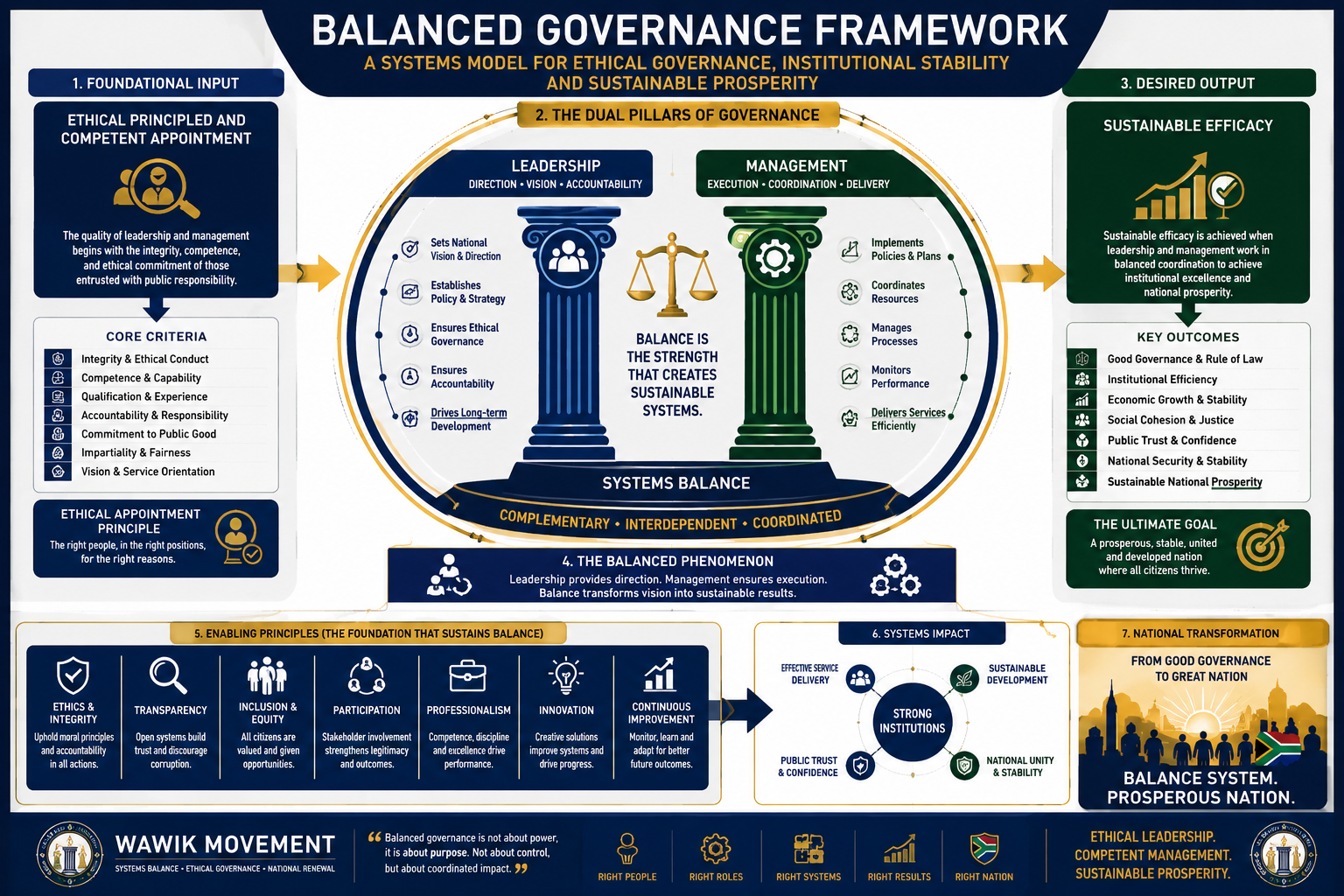
The WAWIK Balanced Governance Framework places strategic leadership and operational management within a complementary institutional architecture.
The Model
The underlying framework is explicitly described in the movement’s organisational document.
Strategic Leadership
- Strategic vision
- Accountability
- Ethical oversight
- Long-term direction
- Institutional coherence
Institutional Balance
Operational Management
- Execution
- Coordination
- Resource control
- Service delivery
- Institutional discipline
Vision without execution cannot deliver outcomes.
The WAWIK framework treats leadership and management as mutually dependent governance functions. Its systems-theoretical premise is that sustainable effectiveness emerges when differentiated functions are appropriately aligned and coordinated.
“Optimal system performance is achieved when roles are specialized and aligned with capability and function.”
Capability
Roles are matched to demonstrated skill and expertise rather than assumption.
Responsibility
Each function carries a clearly defined scope of ownership.
Accountability
Outcomes are traceable to the individuals and institutions responsible for them.
Function
Institutional structures are organised around what each part of government actually does.
Institutional Purpose
Every function is anchored to a defined developmental or governance objective.